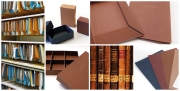
Sustainable protective packaging for cultural, written and library goods
Protective packaging for the archiving of cultural, written and library...
Vulcanized fibre blog
Protective packaging for the archiving of cultural, written and library...

In our last blog post, we showed that numerous products can be manufactured without plastic using vulcanised fibre as an alternative. However, the renewable raw material is also suitable for many other applications in which non-renewable raw materials have been used up to now. In this text, we would like to present three arguments in favour of vulcanised fibre. These arguments show that the limits of potential uses for vulcanised fibre are set primarily by the imagination of engineers.
Our raw materials are finite - and are slowly running out. By 2050 we will already be running out of many building materials and metals that are irreplaceable for modern living standards and a functioning general public. At least that is what some experts predict. Various measures are needed to prevent this scenario. For example, recycling materials and using them more efficiently is only one component. It will also be inevitable to focus much more on renewable raw materials. These are - as the name suggests - not finite, but renewable on a natural basis. Vulcanized fibre, for example, consists of cotton fibres and cellulose. As a result, the material is also 100 percent biodegradable without leaving any residues even in home compost.
The aim must be to use more renewable raw materials in order to reduce the demand for finite raw materials. But can these materials meet the same requirements as conventional materials? In many respects the answer is yes. Let's take vulcanized fiber as an example and consider the material's properties:- high mechanical strength
The combination of high mechanical strength with its low weight makes vulcanized fiber ideal for lightweight construction, for example. Due to its low flammability and high insulation effect, the material is also interesting for mechanical, plant and electrical engineering applications. Ultimately, it is the imagination of the engineers and their willingness to design outside of traditional materials that make the difference.
The investments that companies have to make today in order to integrate renewable raw materials such as vulcanised fibre more strongly into their development processes will pay off in the medium term. A common tool used by politicians is to control markets through higher taxes and subsidies. Companies that rely on renewable resources are likely to profit economically from the changing political climate in the near future. In addition, companies with the appropriate spirit of innovation can already today achieve a pioneering role with regard to renewable raw materials. It is obvious that traditional materials will soon no longer be able to meet demand and prices will rise. Companies must rethink now in order to survive in tomorrow's market - and this applies across all industries.

It is now well known that global plastic production poses a threat to our environment. Our blog has therefore already taken up the topic of environmental pollution through plastic. A solution to this problem could be a traditional material. May we introduce: Vulcanized fiber, the effective alternative with which the world of tomorrow can manufacture numerous products without using plastic.
The vulcanized fibre has been known since 1855 and was first industrially produced in 1859 by Thomas Taylor. The versatile laminate quickly established itself on the market. It was used, for example, to produce suitcases and lampshades. This was made possible by the variable material properties: vulcanized fiber is a hard, tough, non-splintering and hornlike material. It can be bent, embossed, punched, cut, lasered, planed, drilled, milled, coated, printed or glued. However, the most important properties in our time were not even in focus at that time: Vulcanized fiber is based on renewable raw materials (cotton fibers as well as cellulose) and is therefore an ideal substitute for many products and applications based on plastic. In addition, vulcanised fibre can even be degraded in home compost without leaving any residues.
In spite of its diverse material properties, vulcanized fiber has meanwhile been forgotten as a material with innovation potential. Among other things, the invention and industrial mass use of plastics contributed to this. According to researchers at the University of California, about 8.3 billion tons of plastic have been produced worldwide since 1950. Today we are feeling the consequences - and vulcanized fiber is now celebrating its comeback. True to the motto: A classic material saves the world of tomorrow.
In contrast to so-called bioplastics, which often do not decompose completely, vulcanised fibre does not leave any residues even in home compost. The material properties of vulcanised fibre also make this traditional plastic substitute a true all-rounder. The material is suitable for numerous industrial applications. From materials for the automotive sector, lightweight construction in the building industry, medical technology and packaging materials to numerous areas of application in mechanical engineering, the most diverse uses are conceivable with vulcanised fibre.
What once began with lampshades and suitcases can now shape all branches of industry and help to provide the economy with sustainable and environmentally friendly production for the future. In this respect, by no means all possibilities are exhausted, because: Although vulcanised fibre has been around as a material for more than 150 years, its modern use is still in its infancy and offers far-reaching potential for the future. Now it is up to companies to rethink and use a traditional material as the basis for tomorrow's innovations.

The advantages of alternative packaging materials can be very different. Firstly, most materials can be degraded or recycled much better than plastic. In addition, the majority of alternative packaging uses no or significantly less fossil raw materials. Here, renewable raw materials are used. Thus, from an environmental point of view, the alternatives are clearly superior to plastic. Furthermore, plastic also has clear weaknesses in processing and in some other properties. For example, the temperature resistance and wear resistance of plastic are often insufficient. Some of the various alternative packagings have been specially developed so that these weaknesses no longer represent a limitation in processing. Finally, the health consequences of food packaging in particular have not been fully clarified, which could lead to a further need for alternatives in the future.
Vulcanised fibre combines all these advantages. In addition, there are various factors that speak for vulcanised fibre as a material. One of these is that the material is biodegradable, as it is made from the cotton plant. At the same time it is light, flexible and does not splinter. In addition, the material is very temperature-resistant, storable and coatable for alternative packaging. These are all properties that make vulcanised fibre the optimal solution for alternative packaging. The possible applications are almost unlimited and you probably know best which packaging can be made from our material.
If you are interested in vulcanized fibre as an alternative packaging material, we will be happy to assist you. We supply the material vulcanised fibre for your production as rolled or sheet material and support you with technical questions regarding the development of alternative packaging.

Innovative product developments, as they are currently being created again in our partner network InnoNet BL, show it more and more clearly: Sustainable products are becoming more and more important! In order to adapt the properties of vulcanised fibre to the respective product-specific requirements, we are constantly working on new coating possibilities, for example.
The new results of the UV-coated vulcanized fibre look very promising! Thus vulcanized fibre SAVUTEC® is water-repellent and highly smudge-proof.
We are looking forward to future-oriented ideas and feedback!

The first chocolate packaging made of vulcanized fibre SAVUTEC® - we guarantee you 100% natural fibre free of additives for the purest pleasure! The ecological food packaging was first presented at the Chocolart 2016 in the home town of SAVUTEC®, in Wuppertal. Here the tuffi truffles from Wupperliebe were packed in vulcanized fibre. The demand here is very high, which is why the chocolate box, which was originally produced using the laser-cut method, is now manufactured using a cutting plotter and a special printing process.
In order to be able to produce food packaging from vulcanized fibre SAVUTEC®, various processes are used. For example, the material can be both cut and engraved by laser. The engraving creates a real highlight in the presentation, both through the haptics as well as through the subtle colour gradation.
The printing processes specially adapted to the vulcanised fibre SAVUTEC® are also absolutely scratch and abrasion resistant and make the packaging an absolute eye-catcher thanks to rich colours and the contrast between matt and shiny areas.

Continuing the search for new applications for the sustainable vulcanised fibre, the first print samples have now been produced using the screen printing process. The results - surprisingly good hold of the lacquers and a great optic The company Wallraff-Groß Siebdruck & Service from Wuppertal has agreed to test vulcanised fibre SAVUTEC® with various screen printing lacquers.
With their years of experience, they are open to experiments and able to implement new ideas quickly and competently. The enthusiasm for the material was there from the beginning and already the first samples show that vulcanized fibre SAVUTEC® is very well suited as a carrier material. The lacquers adhere well and the structure of the standard vulcanized fibre creates a high-quality appearance.
Especially the combination of the dark material in 0.8 mm thickness and metal lacquer arouses enthusiasm. The UV-cured relief and spot varnishes do not run during the curing process, especially on the smooth fibre, so there are no limits to the design and Vulkanfiber SAVUTEC® offers new possibilities as a high-quality carrier material for a wide range of printed products.

The team of GENERATIONDESIGN GmbH took this year's Restaurant Day at Arrenberg as an opportunity to live out their creativity in the area of Foodtrend with a snack. The combination of many favourite dip variations and different types of bread resulted in an extraordinary and varied taste experience. The food was eaten from handmade bowls made of the sustainable vulcanized fibre SAVUTEC®.
Two other special properties of the material made it the perfect material for the disposable trays - its grease resistance and rigidity. A simple folding technique and the high-quality printing of Wallraff-Groß Siebdruck & Service resulted in wafer-thin bowls of elegant design.

Using an ink-jet printing process, it has been possible to make the electrically outstanding insulating vulcanized fiber partially conductive. The conductive tracks consisting of silver nanoparticles open up a wide range of possibilities for conducting electricity via a flexible, extremely durable natural product. In the future, SAVUTEC® could thus provide the LED lighting of an acoustic light module in addition to its load-bearing function in the acoustic module developed with the InnoNet BL company network.
With calendered smooth fiber and multiple application, the conductivity is to be further increased in further trials of the functional printing process, which is being developed with the Functional Printing research field at the Bergische Universität Wuppertal .

You need to load content from reCAPTCHA to submit the form. Please note that doing so will result in data being shared with third-party providers.
More InformationYou are currently viewing placeholder content from Turnstile. To access the actual content, click the button below. Please note that doing so will result in data being shared with third-party providers.
More InformationYou need to load content from reCAPTCHA to submit the form. Please note that doing so will result in data being shared with third-party providers.
More InformationYou are currently viewing placeholder content from Facebook. To access the actual content, click the button below. Please note that doing so will result in data being shared with third-party providers.
More InformationYou are currently viewing placeholder content from Instagram. To access the actual content, click the button below. Please note that doing so will result in data being shared with third-party providers.
More InformationYou are currently viewing placeholder content from X. To access the actual content, click the button below. Please note that doing so will result in data being shared with third-party providers.
More Information